
The race for critical minerals must respect Indigenous rights
As featured in Environmental Finance.
More than half of the world's remaining intact forests and over 40% of key biodiversity areas are located on Indigenous Peoples' and local communities' lands, according to the World Resources Institute. This is not a coincidence: Indigenous Peoples have safeguarded vital ecosystems for generations.
Recognising and respecting this stewardship is not only a rights issue – it is fundamental to mitigating the systemic risks of climate change and biodiversity loss. COP30's Mutirão Decision explicitly acknowledges that climate action must respect, promote and consider the rights of Indigenous Peoples, including their land rights and traditional knowledge.
At the same time, achieving global climate goals requires a rapid, large-scale energy transition. Electrifying the economy and deploying renewable technologies depend heavily on transition minerals such as lithium, cobalt, copper and rare earths. According to the International Energy Agency, reaching net-zero globally by 2050 will require six times more mineral inputs in 2040 than we use today.
Yet studies estimate that 54% of these minerals and metals are located on or near Indigenous lands. Renewable energy infrastructure (such as wind and solar farms) also requires vast land areas. This convergence of land pressure and mineral demand places Indigenous Peoples at the centre of the energy transition.
For investors, this presents both material risks and strategic opportunities.
AI-driven analytics now give investors the tools to link a company's financial performance with its project-level impacts. When companies fail to engage Indigenous Peoples meaningfully, disregard their rights or damage ecosystems, these actions can trigger social and environmental harm that translate directly into financial and reputational risks.
Inadequate engagement often leads to community responses that result in costly delays, supply chain and operational disruptions, legal disputes and significant budget overruns. Research by the Wharton Impact, Value, and Sustainable Business Initiative shows that for projects within 10km of an Indigenous land claim, the annual incidence of material events, such as halts to operations and regulatory inquiries, increases by as much as 500%, compared with those more than 500km from such a claim.
Conversely, companies that engage early, adapt project designs to address community concerns, build inclusive partnerships with Indigenous Peoples, and establish shared governance and benefit-sharing mechanisms are far more likely to secure trust, accelerate project implementation and avoid costly conflict.
To support investors in navigating these risks and opportunities, US SIF, Rebecca Adamson, founder and president of non-profit First Peoples Worldwide, and ImpactARC collaborated to develop Sustainable Indigenous Finance: Navigating the Energy Transition, an investor guide outlining why and how investors should integrate Indigenous Peoples into investment decision-making.
The guide presents a practical three-tier "de-risking" framework with actionable steps at the institutional, portfolio, and company/project levels.
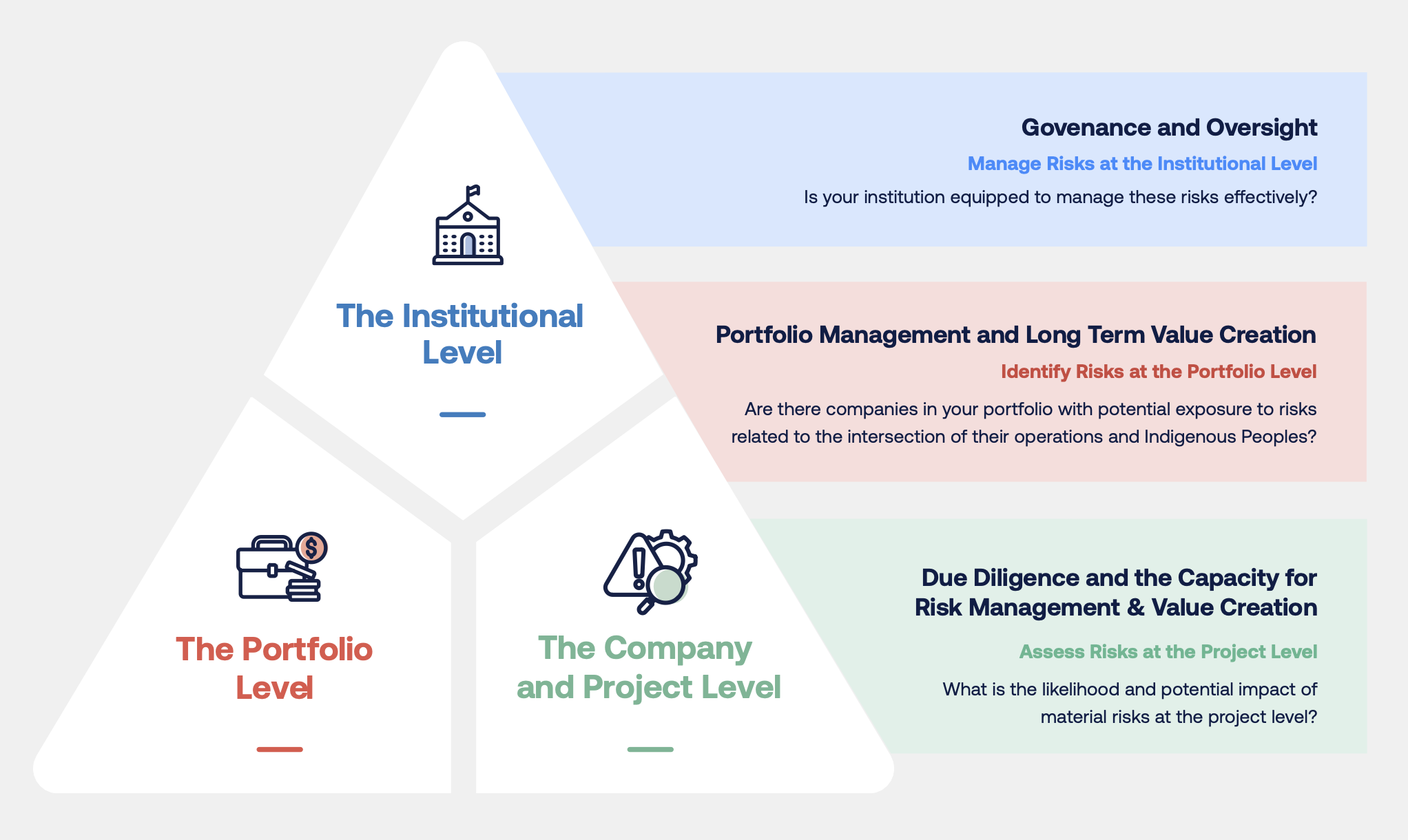
At the institutional level, investors can strengthen their capacity by adopting clear policy commitments, ensuring senior-level oversight, and building internal expertise, including training investment teams and improving data systems.
At the portfolio level, broad screening helps identify companies requiring deeper due diligence. This includes companies operating in high-risk sectors (including extractives, renewables, and infrastructure), high-risk geographies or with a history of community-related controversies.
At the company and project level, deeper due diligence is essential to assess the likelihood and potential impact of identified risks. The guide outlines red flags and green flags to help investors evaluate a company's risk management capacity, the project's risk exposure, and the quality of project-level risk management. It also includes numerous case studies.
Respecting Indigenous rights is not a barrier to the energy transition – it is a prerequisite for doing it responsibly, efficiently, and at scale.
The energy transition will be one of the defining investment challenges of the next decade. Investors who understand and act on the centrality of Indigenous Peoples – not just as stakeholders, but as rights-holders, resource stewards, and essential partners – will be better positioned to anticipate risk, unlock opportunity, and contribute to a just transition.
At ImpactARC, we are eager to center Indigenous Peoples in financial decision-making. If you have ideas, questions, or want to collaborate, please reach out: daisy@impact-arc.com.
Indigenous Photo Credit: Lonnie Anderson, Executive Director of IN•DIG•E•NOUS EC•O•NOM•ICS